
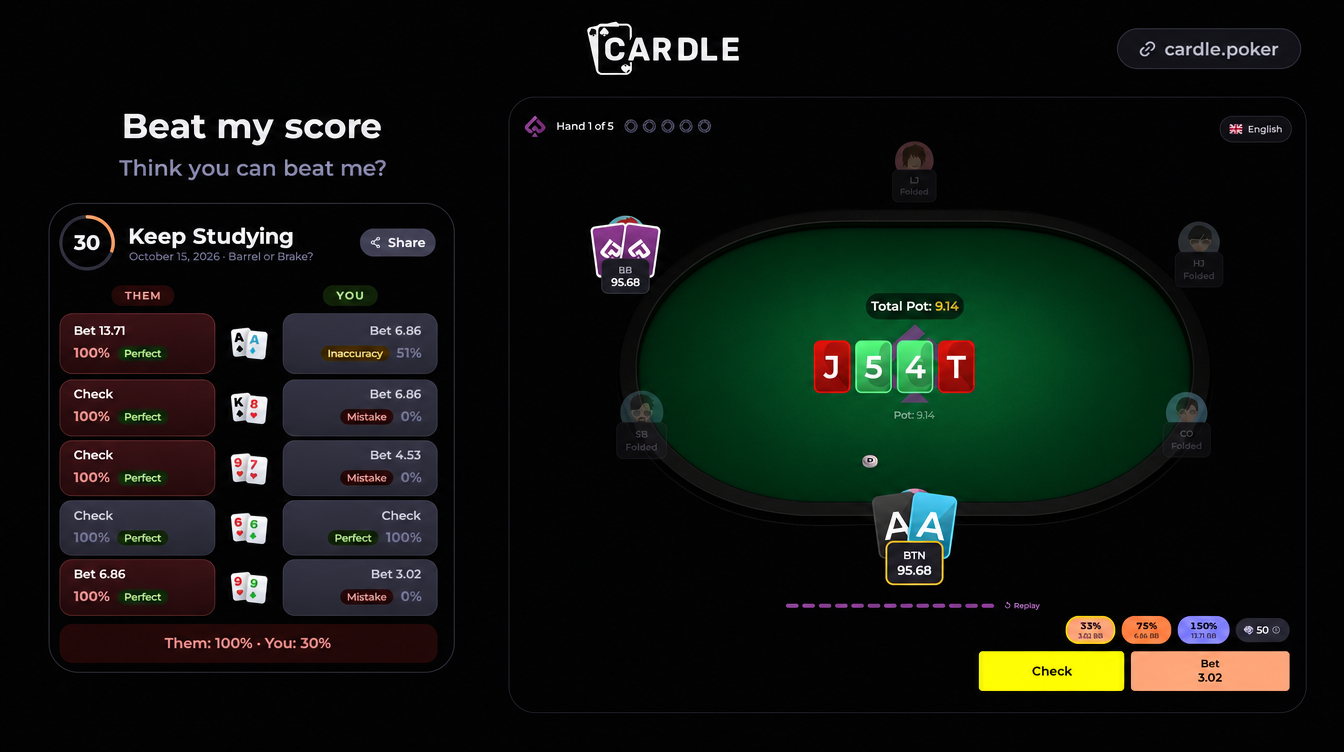
Cardle is a free daily poker quiz from Lucid Poker. Five hands, five real decisions, one score out of 100. It used to live only inside the Lucid app. Now anyone can play it at cardle.poker, with no account and no download.
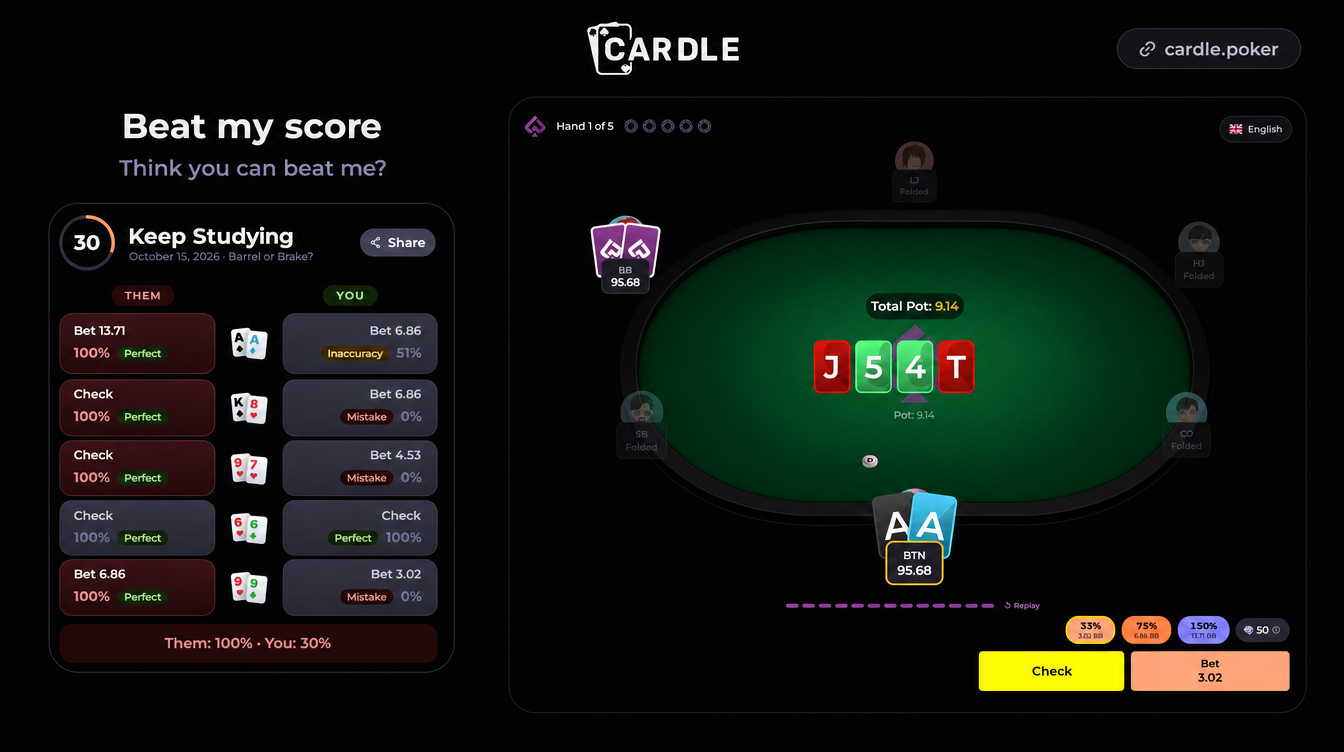
- What it is: a free, daily five-hand poker quiz. The Wordle for poker.
- Where to play: cardle.poker in any browser, or inside the Lucid app.
- What it costs: nothing. No sign-up, no download, no credit card.
- How long it takes: about five minutes a round.
- The twist: send the same five hands to a friend and compare results hand by hand.
Today's five hands are live.
Free. No account. About 5 minutes.
What is Cardle?
Cardle is a set of five poker decisions that refreshes every day. Each spot is hand-picked by Lucid founder Doug Polk to make you think: bluffs, hands that look like bluffs but should check, different bet sizes for value, and a real spread of decisions.
Everyone plays the same five hands that day. That makes every score comparable, which is where the fun starts.
One round gives you:
- Five real spots, preflop and postflop
- A rating on every decision
- A short breakdown of why the best play is best
- A score you can share with friends
Recent sets include "Barrel or Brake?" and "One Flop, Five Hands." The title gives you a hint about the idea the day's hands are built around.
How to play Cardle
-
Open cardle.poker
Today's challenge loads right away. No login screen, nothing to install.
-
Read the spot
You see your position, your cards, stack sizes, the pot, and the action in front of you.
-
Make your play
Fold, call, or raise preflop. Check or pick a bet size postflop.
-
Get your rating
Every decision is rated on the spot, so you know right away whether you found the best play.
-
Read the breakdown
A short explanation shows the solver's answer and what Doug recommends in practice. Then on to the next hand.
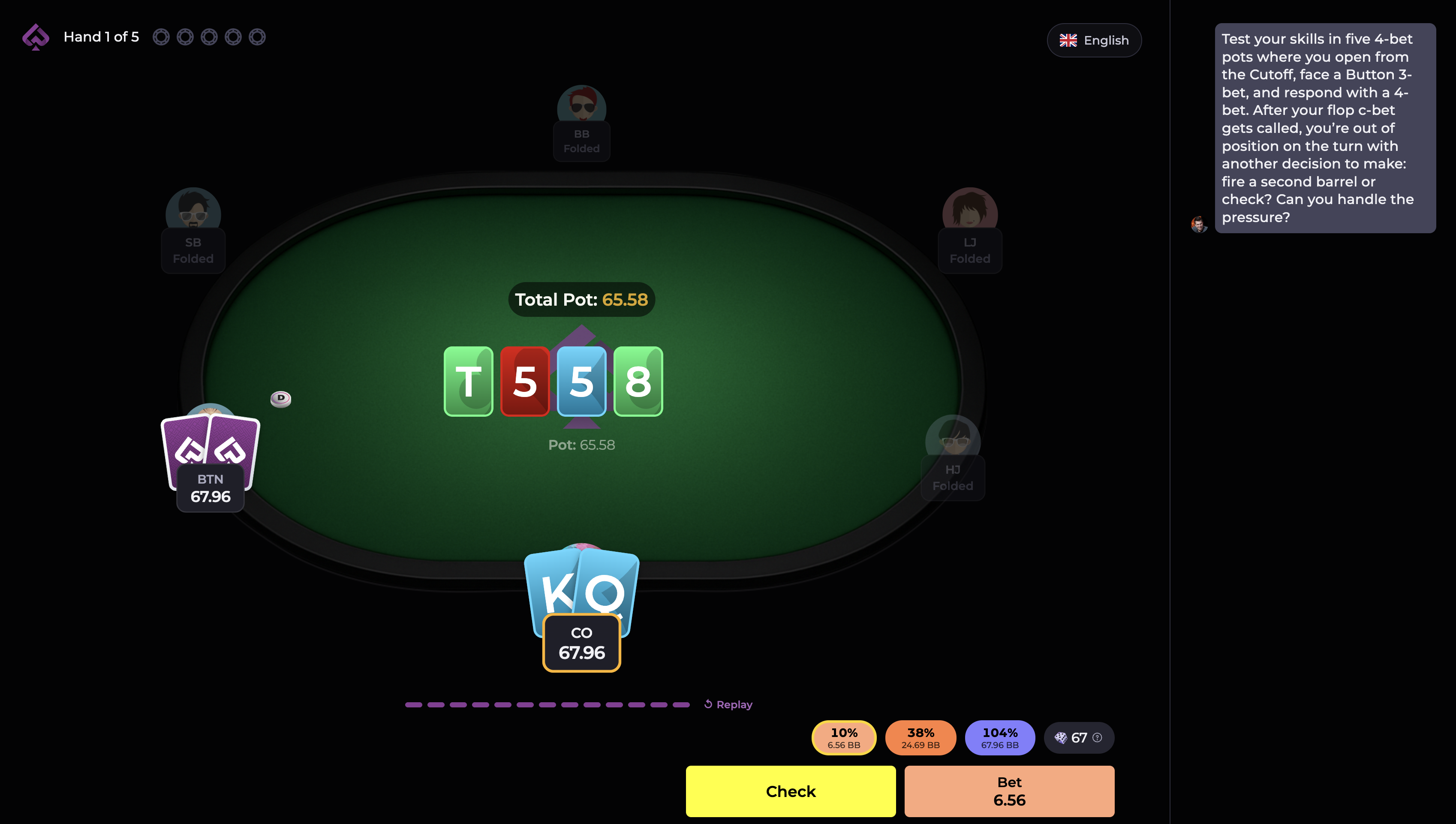
Five hands take about five minutes.
How Cardle scoring works
Your score is out of 100. Each hand earns its own percentage based on how close your choice was to solver strategy, and every decision gets a rating:
Some spots are mixed, meaning the solver takes more than one action with that hand. Those can earn partial credit. That is why a Good decision might score 91% instead of a flat pass or fail.
One bad round means very little. If your misses keep landing on the same kind of spot, like turn barrels or thin river bets, you have found a leak. That is where your next few reps should go.
Challenge your friends
Every poker group has one player who thinks he's the best at the table. The problem is everyone else thinks so too. Cardle settles it.
After you play, tap Share and send the link. Your friend plays the exact same five hands, with no account needed on their end either. When they finish, they see both results side by side, hand by hand.

What a challenge gives you:
- A fair contest. Same cards, same spots, same scoring.
- Receipts. The breakdown shows who made the right play and why.
- Better arguments. A friendly debate over one river check teaches more than most videos.
If you win, you have documented proof. If you lose, you have five hands worth studying.
Post your Cardle link in your home game chat the morning before you play. Everyone shows up having already argued about the same five hands.
Why a daily poker quiz works
Most players study in binges. A long solver session, a course module, a few videos, and then nothing for two weeks. Little of it shows up at the table.
Cardle turns study into small daily reps. Five decisions a day with instant feedback adds up. Over a few weeks, common spots start to feel familiar: when to keep betting, when to slow down, which size fits which hand.
That is the goal. Less guessing in big pots, and faster, calmer decisions when the chips matter.
Built by Doug Polk
Lucid Poker was founded by Doug Polk, one of the most successful heads-up players in poker history. In his High Stakes Feud against Daniel Negreanu, Polk played over 25,000 hands of $200/$400 no-limit hold'em and finished about $1.2 million ahead. His edge came from structured study and deep preparation, and Lucid was at the center of it.
"You shouldn't need to be a full-time pro to train like one."
Doug Polk, founder of Lucid Poker
Cardle packs that approach into five minutes. Polk picks the spots, and every explanation translates solver output into a decision you can make at a real table.
Want more than five hands a day?
Cardle.poker is the daily challenge. The Lucid app is where you train. A free account includes today's Cardle, unlimited preflop training, and a set of postflop reps every day. Lucid Pro unlocks the full archive of 800+ past Cardles plus unlimited drills.
Lucid runs on iOS, Android, Mac, and Windows. You can download the app here, and the Lucid docs walk through every feature.
Cardle FAQ
What is Cardle?
Cardle is a free daily poker quiz from Lucid Poker. You play five hand-picked spots, get each decision rated against solver strategy, and receive a score out of 100.
Is Cardle free?
Yes. Cardle is free at cardle.poker with no account, no download, and no credit card.
How often is there a new Cardle?
Every day. Everyone plays the same five hands that day, so scores are directly comparable.
Is this the same Cardle that is in the Lucid app?
Yes, it is the same game. The web version lets you challenge friends directly, and they do not need an account to play.
Do I need to know GTO to play Cardle?
No. Every hand comes with a short explanation of the best play and why it works, so you learn as you go.
How is Cardle scored?
Each decision gets a rating, from Perfect down to Mistake or Blunder, plus a percentage. Mixed spots can earn partial credit. Your five hands add up to a score out of 100.
How do I challenge a friend on Cardle?
After you finish, tap Share and send the link. Your friend plays the same five hands, then sees both results side by side, hand by hand.
Can I play past Cardles?
Yes, in the Lucid Poker app. Lucid Pro unlocks the full archive of 800+ past Cardles.
Who picks the Cardle hands?
Lucid founder Doug Polk hand-picks every daily set to cover a real range of decisions: bluffs, checks, and value bet sizings.

Can you beat today's Cardle?
You already spend a few minutes a day scrolling. Give five of them to Cardle, then send it to a friend and find out who really runs your table.
Do today's Cardle, free